
In September we launched Trader, our paid guide to flipping, and this month we made our suggestions smarter on the Market, our free page of suggested flips. Today we’re showing our work. Every number on Gielinor Gains comes from testing against real Grand Exchange trades, and now you can see that testing for yourself. Here’s what’s new:
Item pages. Every item we suggest has its own page. It shows today’s suggested trade, how much the tax takes, how the price moved this week, and how our past suggestions for it turned out.
Research. Our first study shows how much flipping really earns now that the game keeps 2% of every sale, with all the data behind it.
Tested plans in Dump Alerts. Dump Alerts are emails that tell you when an item’s price suddenly crashes. Some now include a plan that made money in our tests, and every alert shows the odds.
Tax-free items. The game doesn’t tax 47 cheap items, but we taxed them by mistake. Now their profit is right.
Trader in Firefox. Trader can now follow your trades as they happen in the Firefox browser, not just in Chrome and Edge.
Margins this week. See which items got more profitable to flip this week, and which got less.
Results
We tested the changes to Dump Alerts, Trader and the tax on a month of real past trades. Here’s how they compare with before:
| Result | Now | Before |
|---|---|---|
| Dump AlertsAverage profit per alert, if you followed every one | 28K GP | 5.7K GP |
| TraderAverage profit per trade it picks instead of a dump | 17K GP | 1.9K GP |
| Tax-free itemsTax-free items shown on the Market at one time, on average | 3.0 | 1.5 |
| Tax-free itemsProfit from those suggestions over the month | 3.8M GP | 1.9M GP |
Test month: 17 August to 14 September 2026, after the 2% tax. For Dump Alerts, “Now” is alerts with a tested plan, and we assumed you could get at most 1 in 4 of the items that sold at each price. For Trader, “Before” is the 29 times Trader would have picked a dump, and “Now” is the average of its other picks that month. The tax-free numbers come from a test every 2 hours, 342 in all.
Every item gets its own page
Over 300 items now have their own page: every item the Market suggests today or has a track record for. Click an item’s name on the Market to open it, or browse them all on the Items page. Item pages are free for everyone.
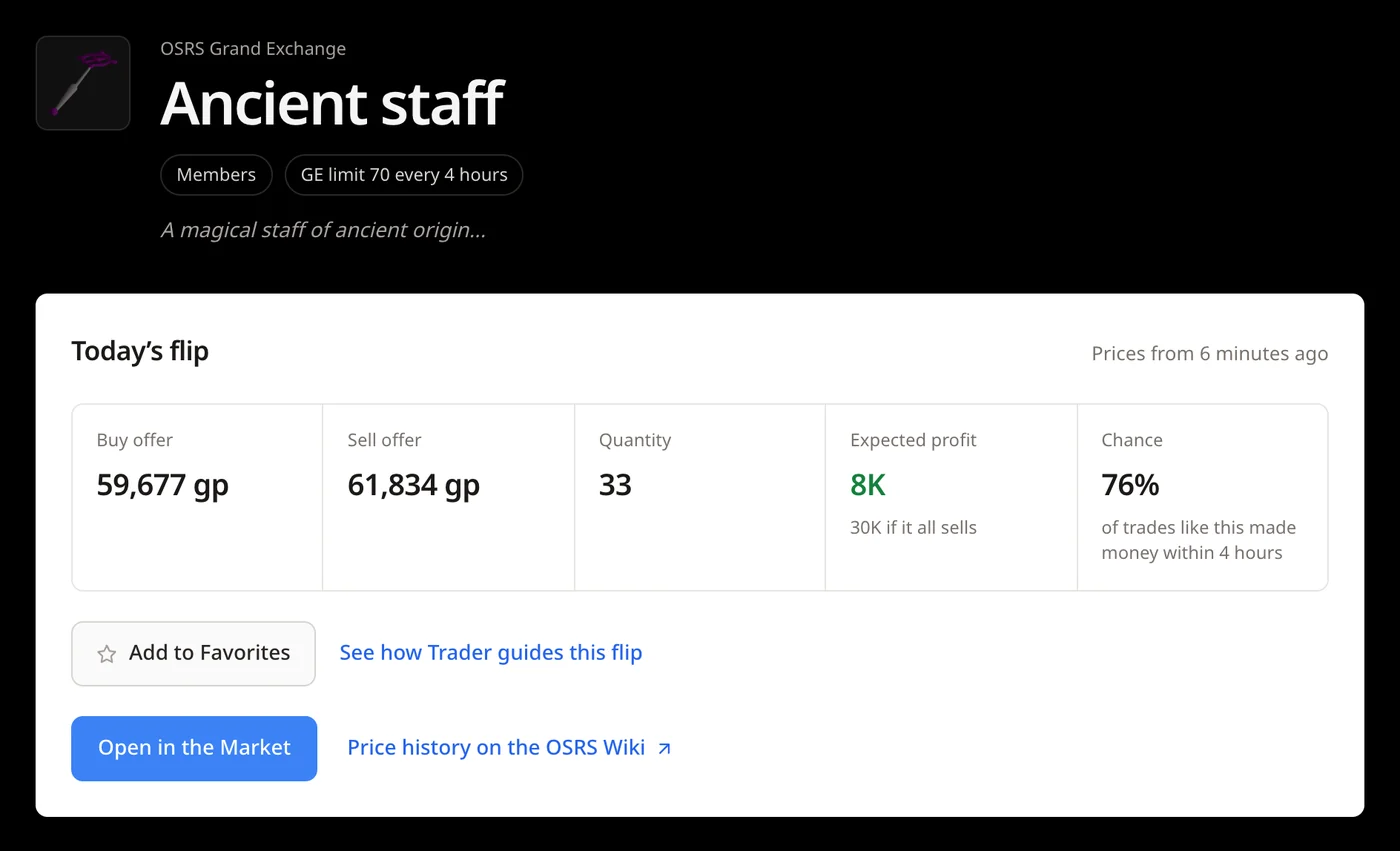
Each page explains its numbers in plain words:
- Today’s flip: the price to buy at and the price to sell at. Also how many to buy (Quantity), the profit to expect, and how often trades like it made money (Chance). Add it to your Favorites, or to Trader if you have it.
- Why these numbers: how much of the profit the tax takes, and the lowest price you can sell at without losing money. It also says what limits how many to buy, like the game’s buy limit (how many of an item you can buy every 4 hours) or how many players are buying.
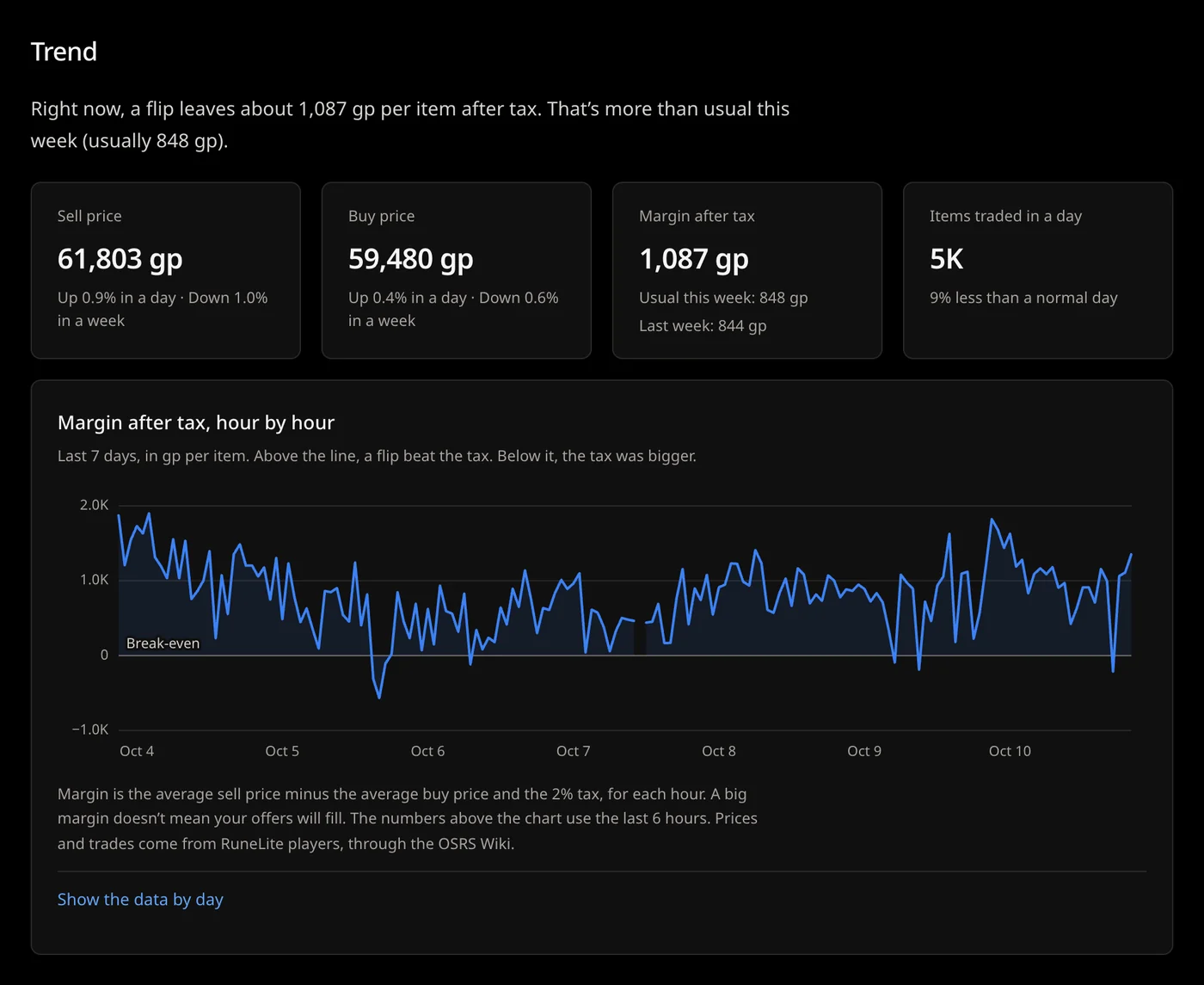
- Trend: how the price moved and how much of the item sold, compared with a normal day. A chart shows the profit after tax for every hour of the last 7 days.
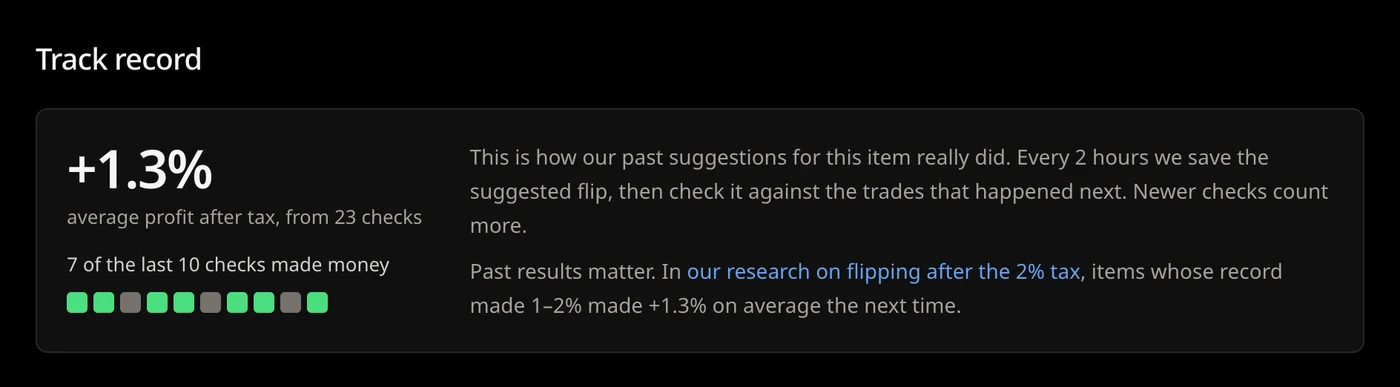
- Track record: how our past suggestions for the item really turned out. Every 2 hours we save our suggestion, then check it against what really happened. The page shows how many of the last 10 checks made money.
- No suggestion today? The page tells you why, in plain words. For example: “The gap between its buy and sell prices is too small to make money after tax.”
- Game updates that changed the item, similar items to look at, and a link to its full price history on the OSRS Wiki.
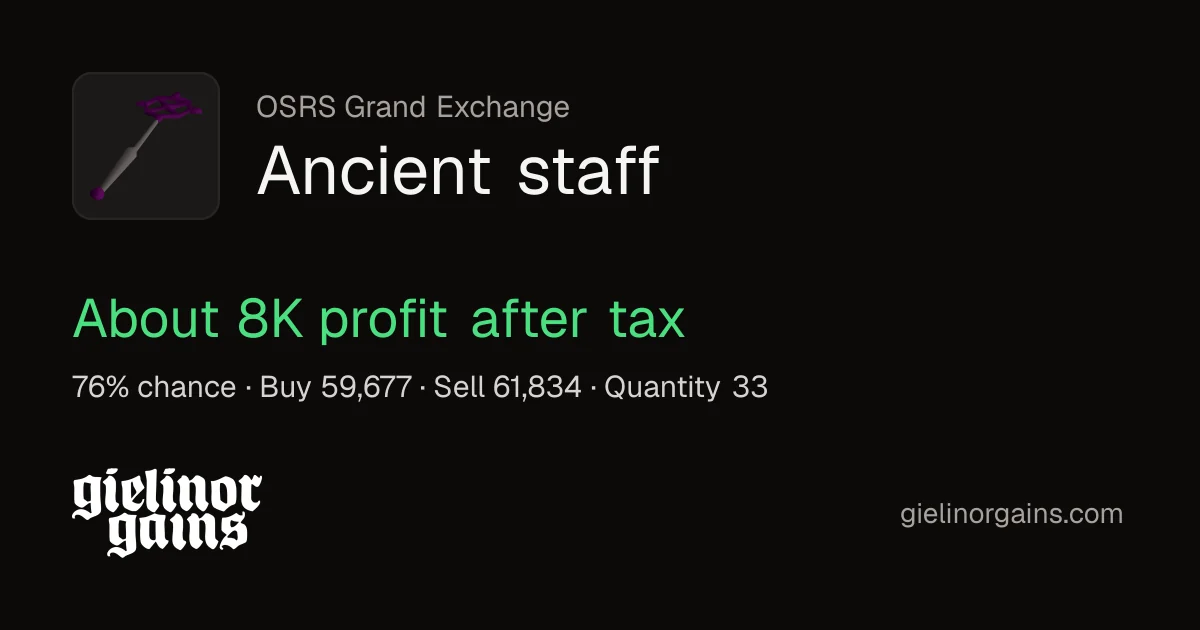
When you share an item page, the link shows a card with today’s suggested trade:
Margins this week
An item’s margin is how much you keep from each one you flip, after the tax. The Items page now shows which items’ margins grew or shrank the most since last week. It also has search, and filters for today’s suggestions and for free-to-play items.
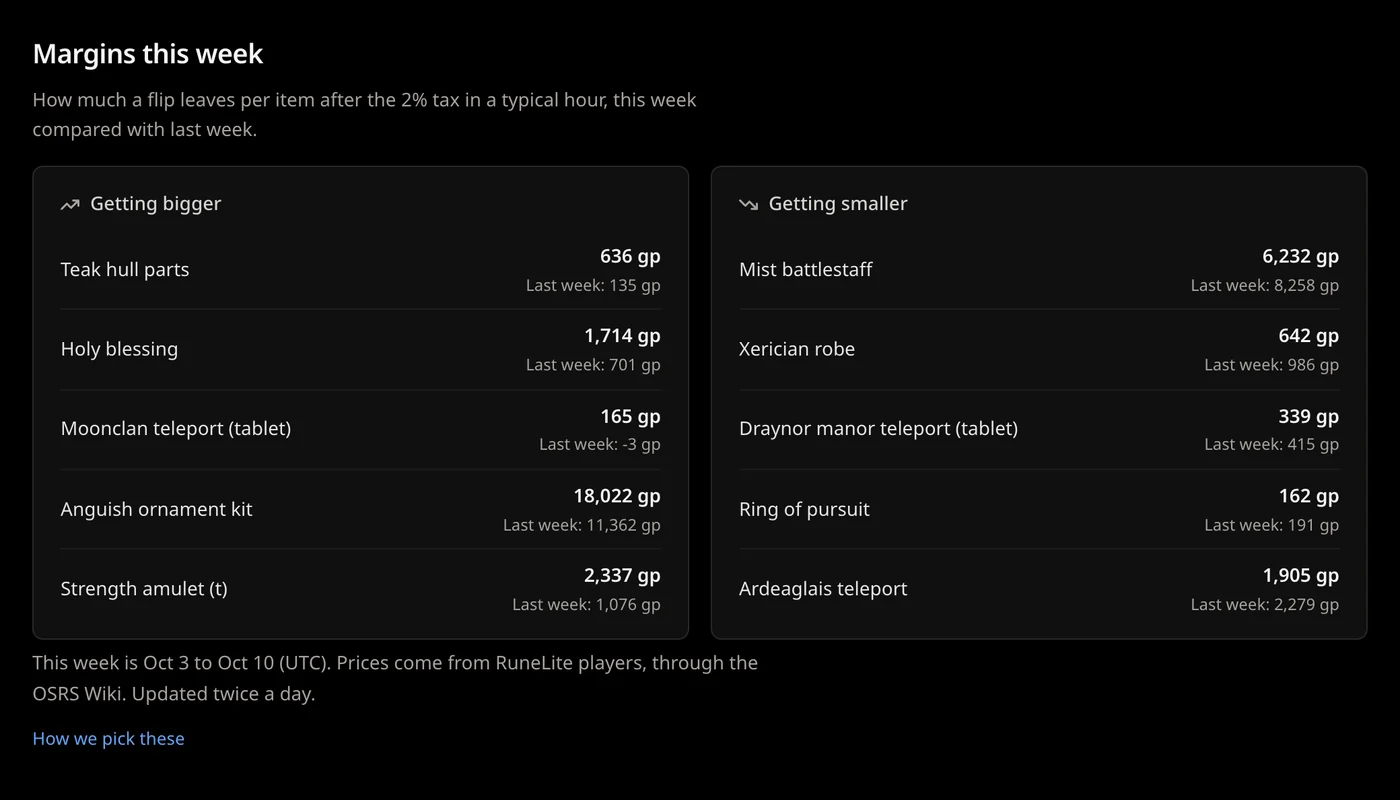
We compare a typical hour this week with a typical hour last week, using the same hourly prices as the item pages. A bigger margin doesn’t mean you’ll be able to buy and sell at those prices, so open an item to see today’s suggestion first.
Research: what flipping really earns
We’re also publishing our research. Our first study asks a question players ask a lot: how much can flipping really earn, now that the game keeps 2% of every sale? (It was 1% until May 2025.) To find out, we used 24 days of real prices and sales for about 4,000 items.
Best possible 4 hours, with 200M GP to trade
The same trades, with only the tax changed
70% lessBest possible 4 hours, with 200M GP to trade, The same trades, with only the tax changed: 1% tax ~2.7M GP, 2% tax ~0.8M GP.
Here’s what we found:
- Even if you could see the future, 4 hours of flipping with 10M GP made about 400K–540K GP on average. That’s the ceiling. Real trading makes much less.
- The typical gap between buy and sell prices was 1.4%. That’s enough to beat a 1% tax, but not today’s 2%.
- The best real strategy we found was Trader using item track records. It made about 134K–147K GP every 4 hours, in a test month we didn’t use while building it, so the test was fair.
- Five popular ideas lost money or earned very little, like buying lots more of each item, or buying every price drop. Only some dumps worked, as you’ll see below.
- An item’s track record matters. Items whose past suggestions made over 5% made about 8.5% on the next one.
Every finding comes with a 95% range, which means we’re 95% sure the true number is inside it. You’ll also see how we tested it, and data you can download. Read the study.
Dump Alerts with a tested plan
A dump is when players sell a lot of one item at once, and its price suddenly drops. We went back through seven weeks of real trades to see what happens next. Most dumps bounce back, and fast. A dump usually drops the price about 20%. Five minutes later, the price is usually only 5% below normal.
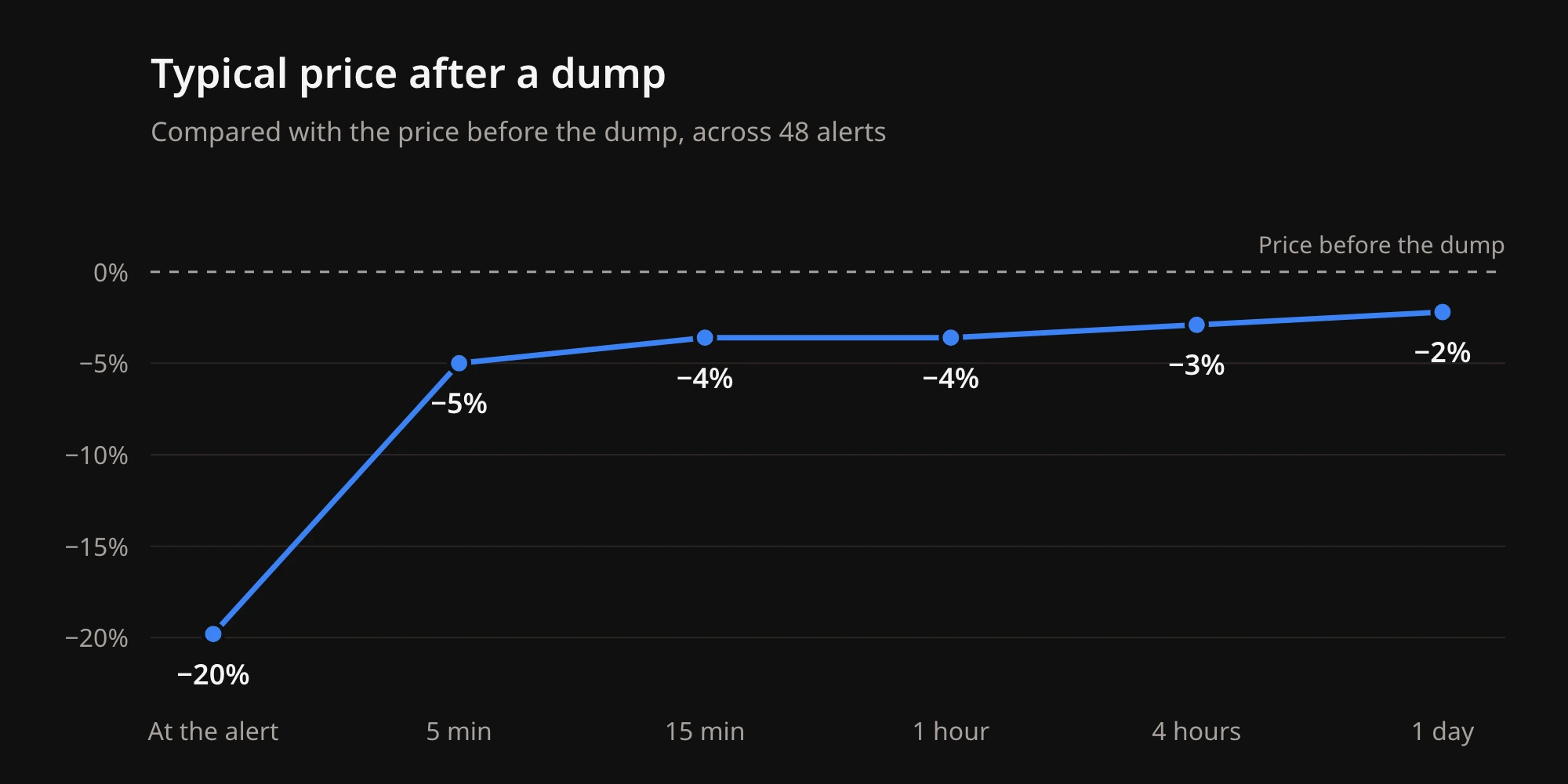
So for most dumps, the lowest price is gone before you can act on an email. But not every dump is the same. On some medium-sized dumps, sellers keep coming back for hours, and the price dips back down. An offer to buy at the dump price, left up for a day, usually goes through. Then the price comes back within a couple of days. That’s where the tested plan comes from.
A Dump Alert includes a tested plan when the dump looks like the ones where the plan worked:
- The price fell between 10% and 20%.
- The item is worth at least 1,000 GP.
- It isn’t one of the most traded items on the Grand Exchange.
- The plan could make at least 50K GP if everything you buy sells. Smaller ones aren’t worth an email.
The plan is simple. Offer to buy at the price in the email, and leave the offer up for a day. Then sell at the item’s usual price from before the dump. If it hasn’t sold after 2 days, sell at whatever price buyers are paying.
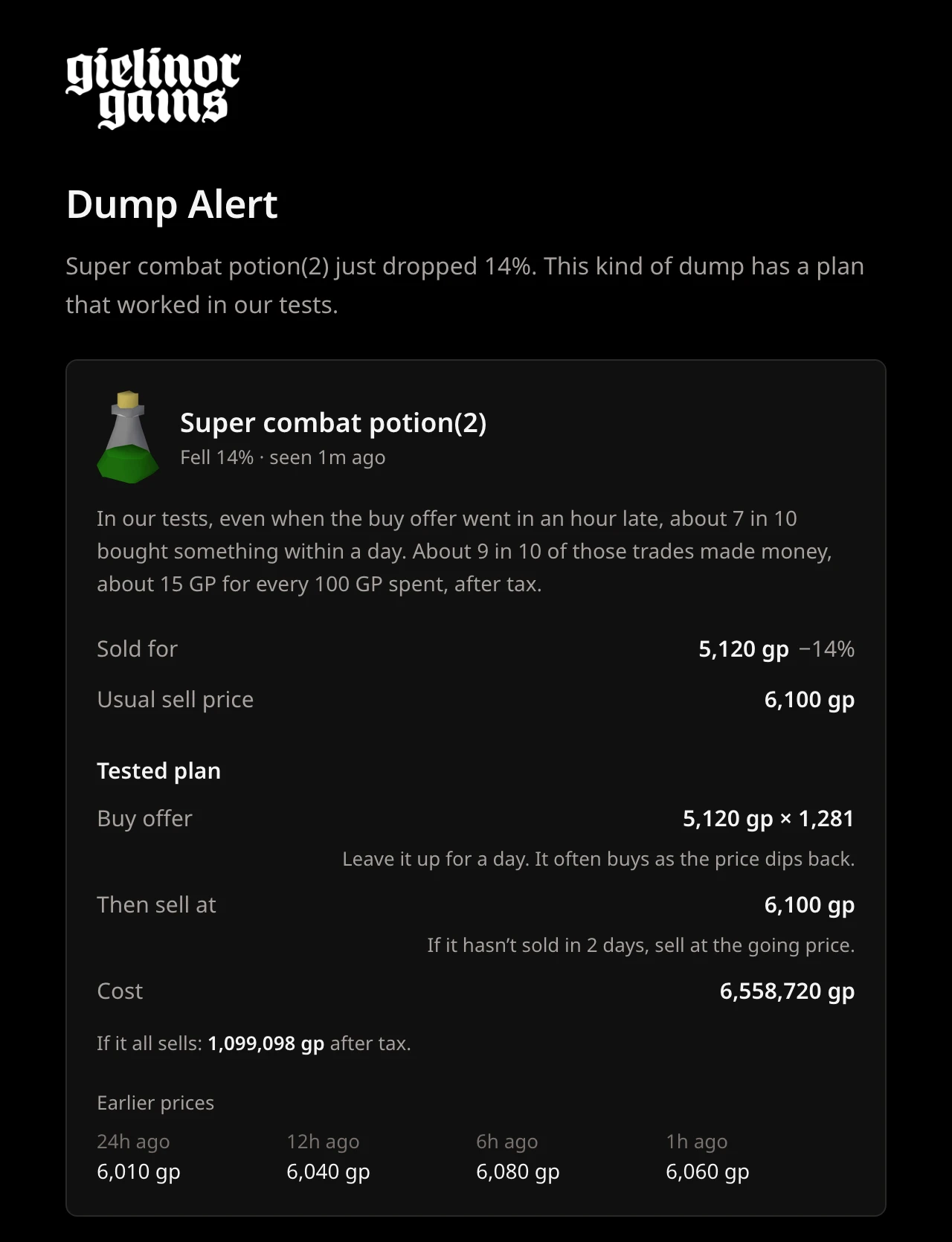
To check that the dump really mattered, we also tried the same plan on the same items on a normal day, 2 to 3 days earlier:
| In the test month | Tested plan | Same item, normal day |
|---|---|---|
| Buy offers that went through, at least partly | 76% | 94% |
| Of those, trades that made money | 90% | 75% |
| Profit for every 100 GP spent | 16 GP | 1 GP |
You don’t have to be instant. Even when the buy offer went in an hour late, 71% still went through. 86% of those made money, and the plan still made 15 GP for every 100 GP spent.
Big dumps that don’t fit the plan still get a Dump Alert as soon as we spot them. Those alerts now start with what happened, not a profit number. They tell you what usually happens next, and what to do if you already own the item:
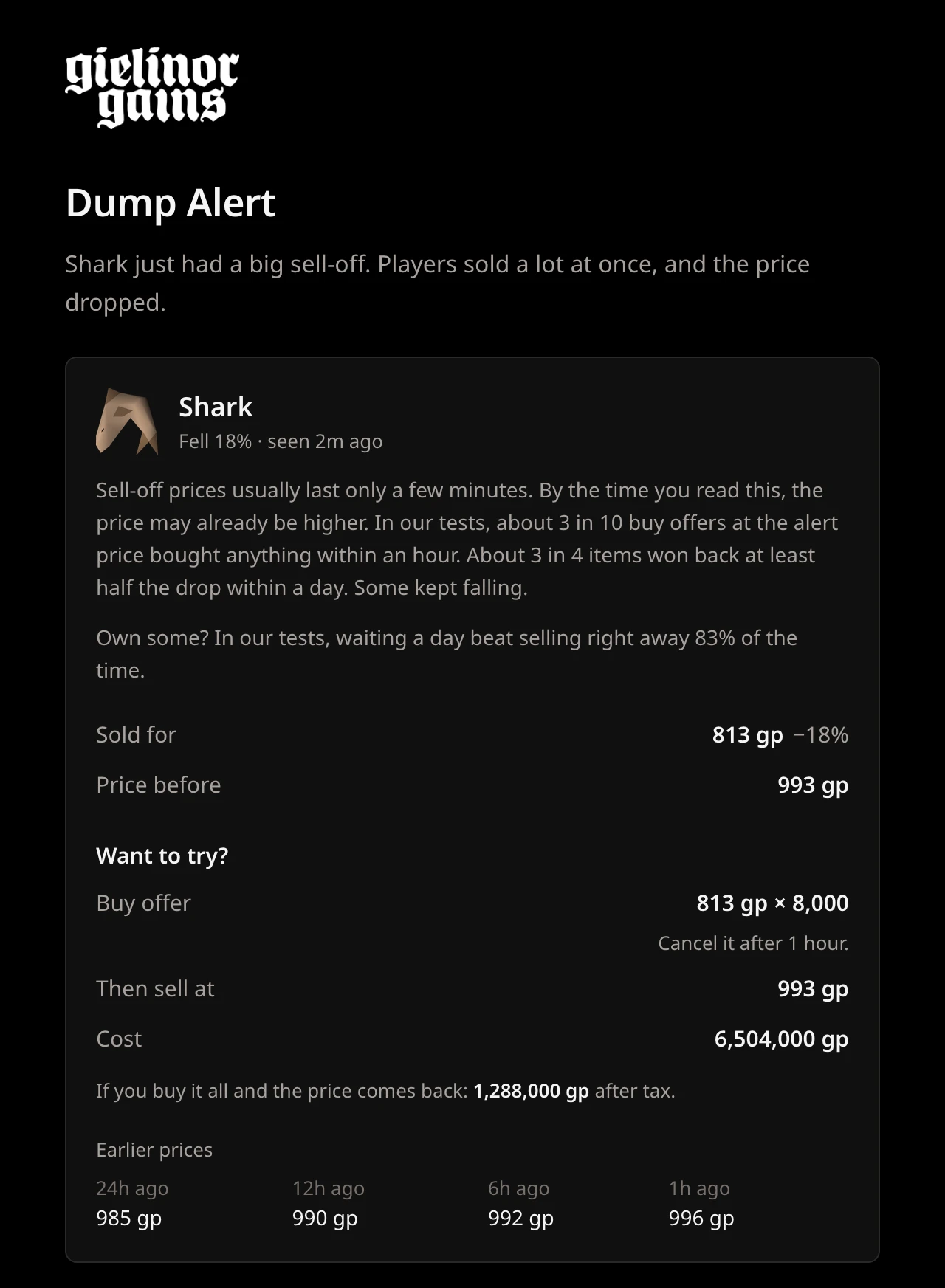
| What these Dump Alerts say | What happened in our tests |
|---|---|
| The low price usually lasts only a few minutes | The drop shrank from 20% to 5% in 5 minutes |
| About 3 in 10 buy offers went through within an hour | 29% (14 of 48) |
| About 3 in 4 items won back half the drop within a day | 74% (35 of 47) |
| If you own the item, waiting a day beat selling right away 83% of the time | 83% (39 of 47) |
Our emails have a new look too. They’re dark, clean and easy to read on a phone, and the subject line says what happened, like “Dump Alert: Shark fell 18%”. Profit on a dump is labeled “if it works” or “if it all sells”, because it isn’t certain.
Trader used to pick dumps first, ahead of every other trade. Most of those buy offers never went through, and the ones that did were often for items that kept falling. In the test month, those trades made about 1.9K GP each, while Trader’s other picks made about 17K. So Trader no longer picks dumps for you. You can still add one yourself from the Dumps list, and Trader will show you the odds first.
Tax-free items now show their real profit
The game doesn’t tax 47 cheap items, such as lobsters, Energy potions, Mind runes, some teleport items and tools like the hammer and chisel. Jagex made them tax-free in 2021 and 2025. Our calculator only knew two exceptions. Sales under 50 GP aren’t taxed, and bonds pay a special fee. So it charged these 47 items the full 2% tax. That made their profit look smaller than it was, and hid some good trades.
Now they’re untaxed everywhere: on the Market, in Trader, in track records and in our tests. Here’s what that means for one flip:
| Item | Buy → sell | Before | Now |
|---|---|---|---|
| Teleport to house (tablet) | 575 → 580 | −6 | +5 |
| Ring of dueling(8) | 840 → 855 | −2 | +15 |
| Civitas illa fortis teleport | 874 → 895 | +4 | +21 |
| Energy potion(4) | 168 → 174 | +3 | +6 |
Some of these trades looked like a loss before. They weren’t. In our tests, the Market suggested tax-free items twice as often, and those trades made about twice as much. Overall profit for the Market and Trader stayed about the same, because few suggestions are tax-free. This fix is about getting every number right.
Trader now works in Firefox
Trader follows your trades as they happen by reading files that RuneLite saves on your computer. That used to work only in the Chrome and Edge browsers. Now it works in Firefox too. Here’s how to connect:
- Install Exchange Logger, a free RuneLite add-on that writes down each of your trades. Trader’s setup guide shows the settings to use.
- Open Trader in Firefox on the computer where you play.
- Choose two files: RuneLite’s save file and your Exchange Logger file. Firefox can’t open folders, so you choose these two files instead. Trader shows where to find each one on Mac, Windows and Linux.
- Select Start following, and keep Trader open on screen while you trade.
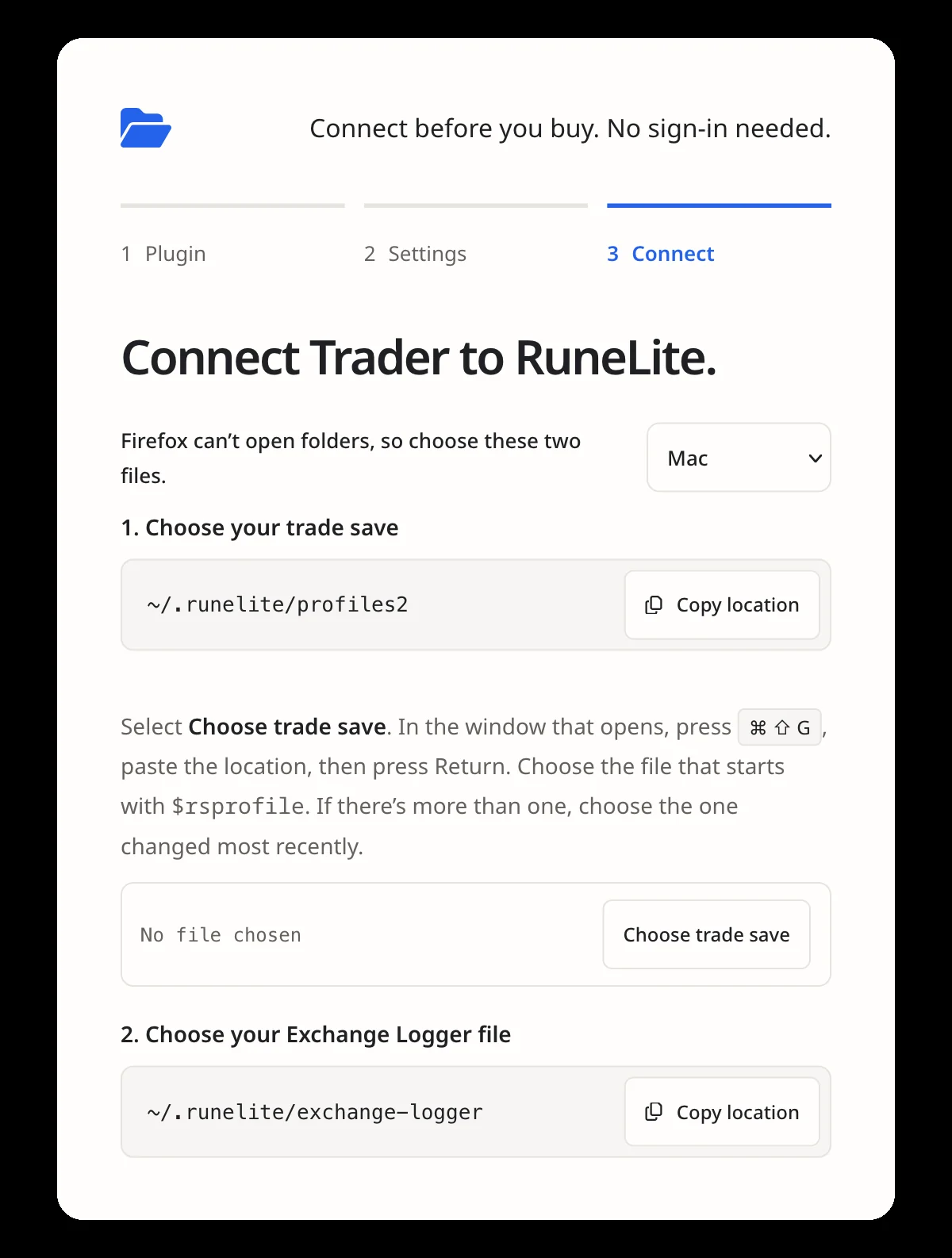
- The save file shows your offers right now, and the Exchange Logger file shows each change as it happens. Changes usually show up in Trader within a few seconds, the same as in Chrome and Edge.
- Firefox keeps those files while your Trader tab stays open, even if you reload the page. If you open Trader in a new tab, you’ll choose them again. Chrome and Edge remember your folder.
- Trader only reads the two files you choose. Your files stay on your computer. Trader only sends the item numbers it needs to check prices.
- Safari still can’t follow RuneLite’s files, so it can only load your trades once, not follow them as they change. Phones and tablets can’t connect, because RuneLite’s files aren’t on them.
Ready to try it? Open Trader in Firefox.
Also in this update
- The Market explains flipping in plain words, with answers to common questions, like how the tax works and when buy limits reset.
- We use the same word everywhere for how many to buy: Quantity.
- Item names in Market Updates, our notes on game updates that move prices, now link to their item pages.
- Sign-in, password and contact emails share the new dark design.
What to keep in mind
These numbers come from testing. They’re a guide, not a promise. A few things to know:
- About 1 in 10 tested-plan trades lost money in our tests. A tested plan can tie up your GP for up to 2 days, and buying everything it suggests can cost several million GP. You can buy fewer.
- Everyone with Dump Alerts gets the same emails, so other players may try the same trade.
- We tuned when to send tested plans using this same test data, so real results may be lower. We’ll check every tested plan from now on and share the results here.
- Some newly suggested teleport items sell more slowly than you might hope. The expected profit we show already allows for that.
- Item pages and margins use prices that RuneLite players share through the OSRS Wiki. A big margin doesn’t mean your offers will go through.
- Track records started keeping each item’s last 10 checks with this update, so most items will show fewer than 10 at first.
- Firefox support depends on how Firefox handles chosen files. If a future version changes that, Trader will ask you to choose your files again.
- We never trade for you. You place every offer yourself, in the game.
How we tested
For Dump Alerts, we used the site’s own code to work out what it would have done every 5 minutes, over weeks of real past trades. Then we checked how each trade would have gone, after the tax. We wrote down each test before running it, and tested the first version of the plan once, on a month we had set aside. It passed. After that, we used both months to choose when to send the plan and which plans to email.
For tax-free items, we ran the Market and Trader over that same month of past trades, with and without the fix. We checked the result once, against 15 pass-or-fail rules we wrote down in advance. It passed all of them.
For the research, we tested 280 starting times, one every 2 hours, from 15 September to 8 October 2026. An offer only counted as going through if real players traded at its price. Trader’s test month wasn’t used while building it, and was checked once. The study lists every number, its 95% range and the data behind it.
For margins this week, we first tried using one average price per day, which is much faster. Checked against hourly prices, it got the direction of the change wrong for about 1 item in 5. So we use the same hourly prices as the item pages.
What’s next
We’ll track every tested plan we send and share how they do. Track records will keep filling in, and we’ll keep testing our suggestions on new market data. More research is on the way. When something stops working, we’ll fix it and tell you here.